Atlantis: Fabled City or Ancient Civilization?
Few lost places have been searched for as often as Atlantis. Writers and film-makers have looked for it for centuries; a Discovery Channel documentary on the question was broadcast on 3 February 2010. But the answer to “fabled city or ancient civilization?” starts with a single author.
One source: Plato
The only primary sources for Atlantis are two dialogues by the Greek philosopher Plato, Timaeus and Critias, written around 360 BC. Every later mention of the island is based on them. In Plato’s story:
- the tale came from the Athenian statesman Solon, who was said to have heard it from Egyptian records while visiting Egypt between 590 and 580 BC;
- Atlantis was an island “larger than Libya and Asia together”, lying beyond the Pillars of Hercules, the Strait of Gibraltar;
- 9,000 years before Solon’s time it was a naval empire that conquered much of Europe and Libya, until it was defeated by an early Athens;
- having lost the favour of the gods, it sank into the sea.
Why scholars call it fiction
Present-day classicists and philologists agree that the story is fictional. Plato used Atlantis as an allegory about the pride of nations: a sea power from the west set against the great land empire of the Persians in the east, and defeated by an Athens modelled on the ideal state of his Republic. Even in antiquity, Aristotle, Plato’s pupil, believed his teacher had invented the island to teach philosophy.
How the myth grew
Renaissance writers took up the allegory: Thomas More’s Utopia and Francis Bacon’s New Atlantis both drew on it. The modern search for a real Atlantis began with Atlantis: The Antediluvian World, published in 1882 by Ignatius Donnelly, who argued that all ancient civilisations descended from it. He is credited as the father of the 19th-century Atlantis revival. Helena Blavatsky built on his ideas in The Secret Doctrine in 1888. Since then, “Atlantis” has become a byword for any supposed advanced lost civilisation.
What might have inspired Plato
The debate today is about inspiration, not location. Some scholars point to real disasters Plato could have heard of:
- The Thera eruption on today’s Santorini, in the 17th or 16th century BC, which caused a large tsunami that some experts believe devastated the Minoan civilisation on Crete;
- the Sea Peoples’ invasions or the Trojan War, possibly preserved in Egyptian records.
Others think Plato drew on events of his own time, such as the failed Athenian invasion of Sicily in 415–413 BC, or the destruction of the Greek town of Helike in 373 BC.
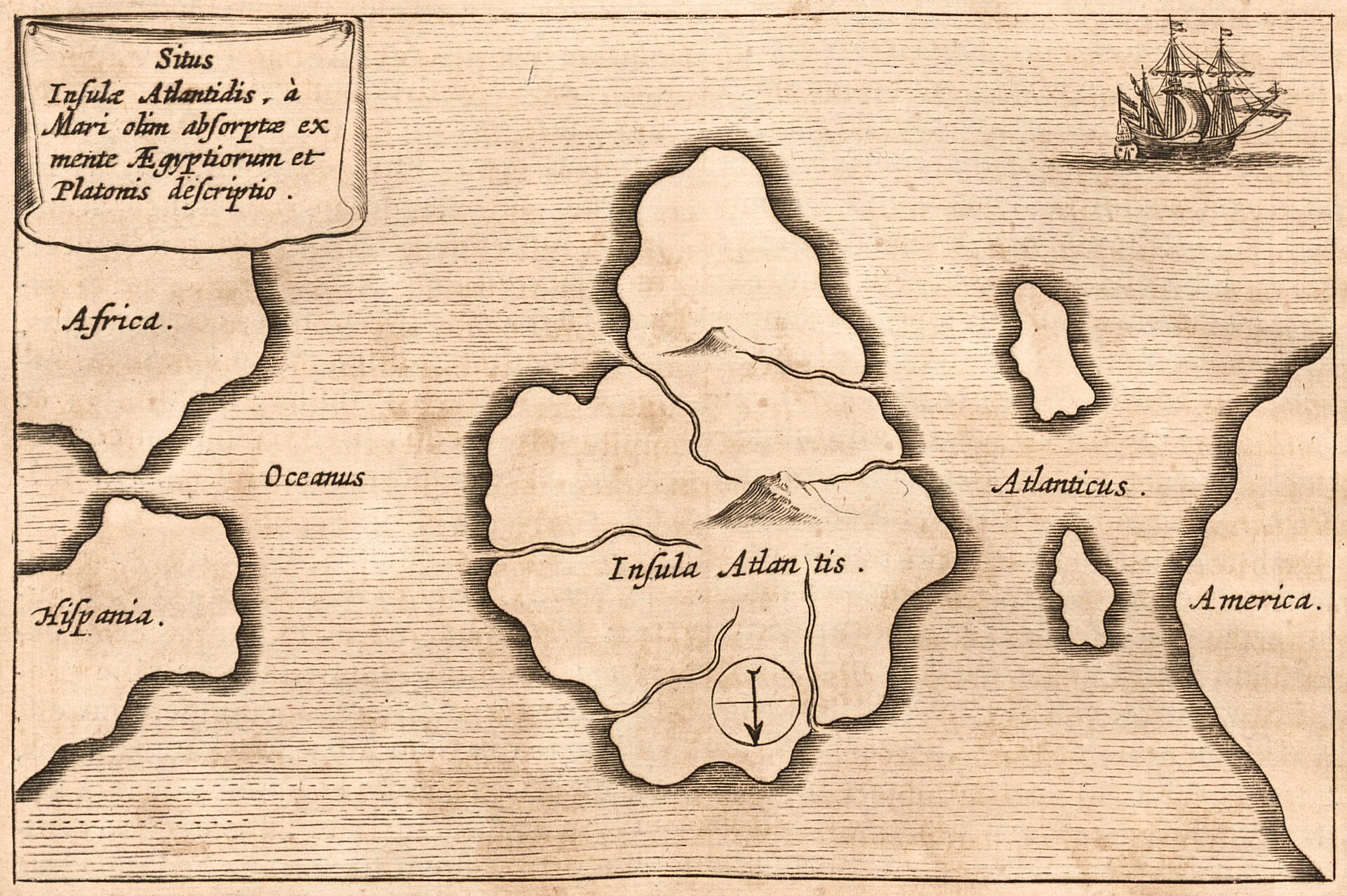
Photo: A map of Atlantis drawn by Athanasius Kircher in 1678, placing it in the Atlantic. By Athanasius Kircher, Wikimedia Commons, Public domain.