Inside the Svalbard Seed Vault, the World’s Backup for Crops
On the Arctic island of Spitsbergen, 130 metres inside a sandstone mountain, Norway keeps a backup of the world’s crops. The Svalbard Global Seed Vault opened on 26 February 2008. As of June 2025 it held 1,355,591 seed samples, representing more than 13,000 years of agricultural history.
How it works
- The seeds are copies of samples held by gene banks around the world. Depositing them is free.
- It works like a safe-deposit box: Norway owns the building, and each gene bank owns the seeds it sends. Nobody else can take them out.
- Seeds are sealed in three-layer foil packets and stored at −18 °C.
- The site was chosen for its permafrost and lack of tectonic activity, and because, 130 metres above sea level, it should stay dry even if the ice caps melt.
- There are no permanent staff on site.
Norway paid the whole construction cost of about 45 million kroner, US$8.8 million in 2008. The vault is run under an agreement between the Norwegian government, the Crop Trust and the Nordic Genetic Resource Center. The idea was championed by the conservationist Cary Fowler.
The only withdrawals: Syria
The vault’s mission is to back up gene banks against accidental loss, and that is how it has been used. During the Syrian civil war, the International Center for Agricultural Research in the Dry Areas (ICARDA) could no longer run its gene bank at Tel Hadya. In 2015 it withdrew some of its backup seeds, and in 2017 it made a second, larger withdrawal. The seeds were grown in Lebanon and Morocco; some were returned to Svalbard and others stocked new gene banks in those countries. As of May 2024 these were the only withdrawals ever made.
A warm autumn
In October 2016 unusually high temperatures and heavy rain let water run 15 metres into the 100-metre entrance tunnel, where it froze. The seeds were never at risk, but Norway’s public works agency improved the tunnel in 2019 to keep water out.
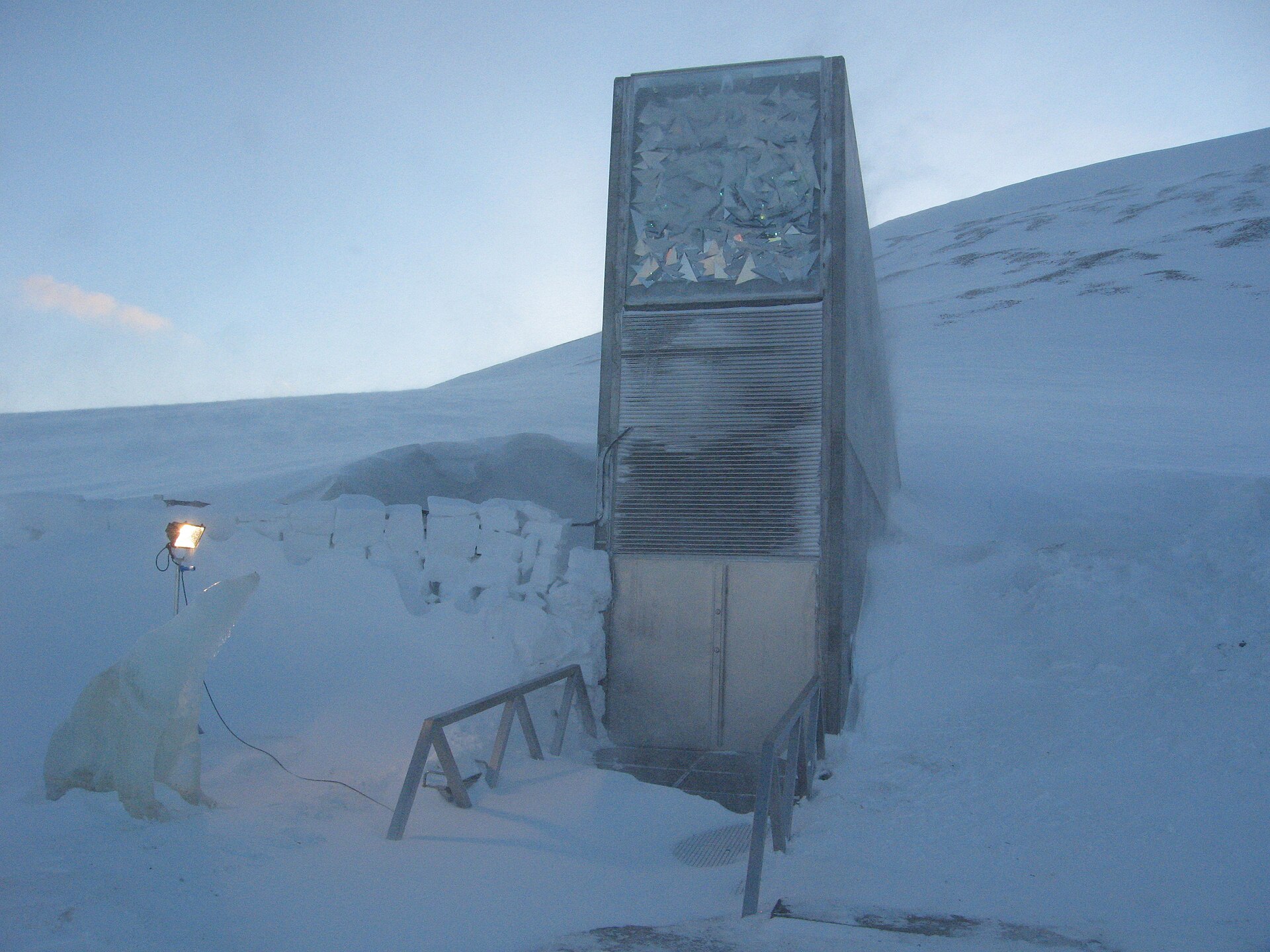
Photo: The entrance to the Svalbard Global Seed Vault in February 2008. By Dag Endresen, Wikimedia Commons, CC BY 3.0.