Was Robin Hood Real? What the Records and the Ballads Say
Every age has retold Robin Hood: the archer of Sherwood Forest, his Merry Men, Maid Marian and the Sheriff of Nottingham. In May 2010 he was the subject of the last episode of the Discovery series Solving History with Olly Steeds, shown in Britain as Mystery Investigator. The question behind all of it is simple: was there a real Robin Hood?
The earliest mentions
- The 1370s: the poem Piers Plowman contains the first clear reference to “rhymes of Robin Hood”.
- About 1402: a proverb is already quoted: “many men speak of Robin Hood and never shot his bow”.
- 1426: the first record of a Robin Hood game, or play, in Exeter. Such games became part of May Day festivities, and Maid Marian appears to have joined the legend through them.
- Late 15th century: the earliest surviving copies of the ballads themselves, such as Robin Hood and the Monk.
- About 1500: A Gest of Robyn Hode, the first printed version, joins separate stories into one narrative.
Not quite the Robin we know
The early Robin is rougher than the modern hero. In Robin Hood and the Monk he is quick-tempered and violent, and attacks Little John for beating him at archery. In the oldest versions he is a yeoman, not a nobleman. The Gest names the king as “Edward”, not Richard. The picture of Robin as a loyal supporter of Richard the Lionheart, fighting Prince John while Richard was on crusade, first became popular in the 16th century. And the first explicit statement that he habitually robbed the rich to give to the poor comes in John Stow’s Annales of England of 1592.
Real outlaws with the name
The oldest legal record of a person called Robin Hood is from 1226: at the York assizes, a Robert Hod had goods worth 32 shillings and 6 pence confiscated and was outlawed. From 1261 onwards, names like “Robinhood”, “Robehod” and “Robbehod” appear in English court rolls as nicknames for wrongdoers. In 1262 in Berkshire, the surname “Robehod” was given to a man apparently because he had been outlawed.
That has led historians such as John Maddicott to suggest that “Robin Hood” was a stock alias for outlaws in general. In the 19th century, the antiquarian Joseph Hunter argued instead for a Robert Hood living in Wakefield, Yorkshire, in the early 14th century. Historians and folklorists have proposed at least eight plausible origins for the story, and none has been proved.
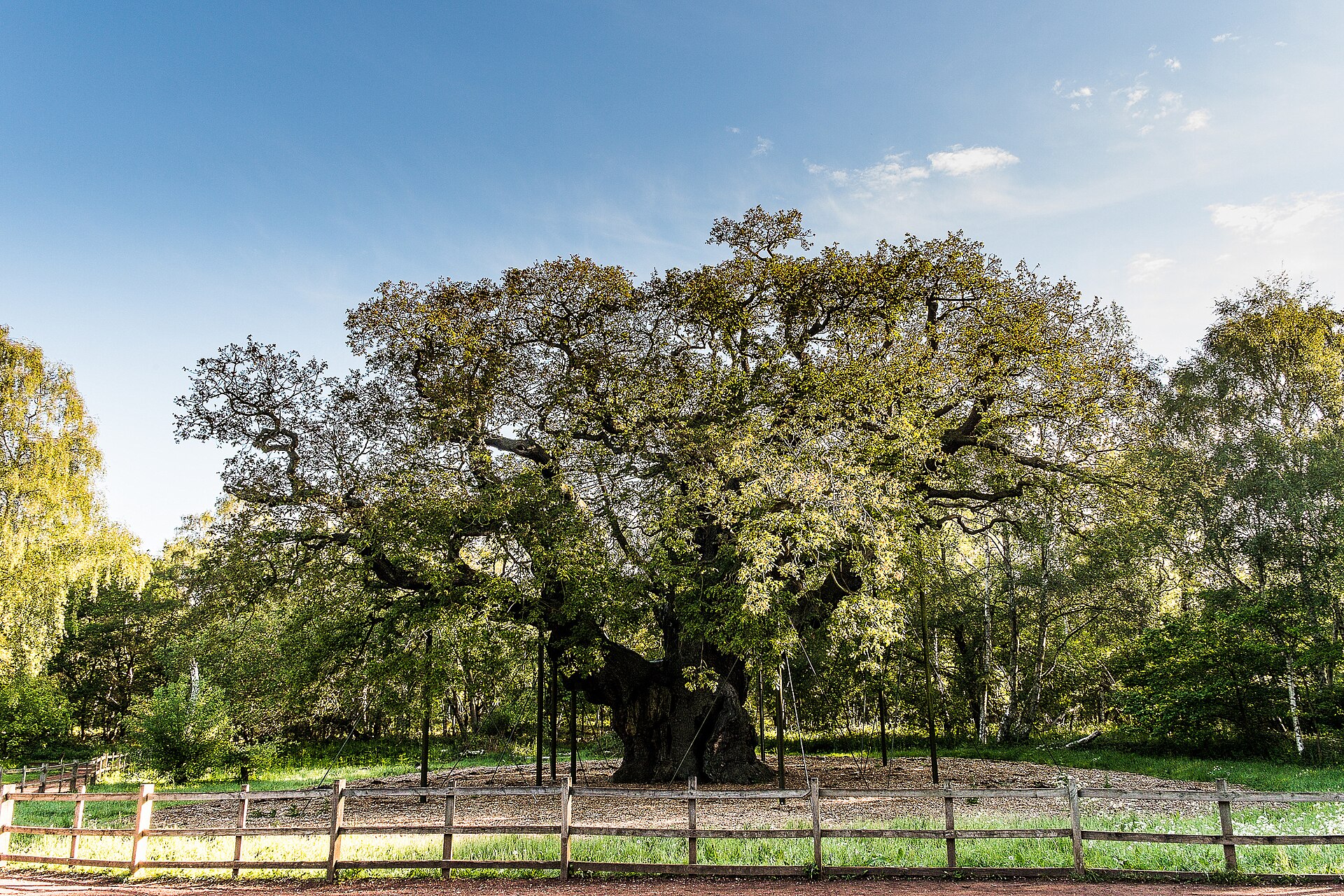
Photo: The Major Oak in Sherwood Forest, Nottinghamshire. By Ema Lee, Wikimedia Commons, CC BY-SA 4.0.