The Poisonous Green That Papered Victorian Homes
In 1775 the Swedish chemist Carl Wilhelm Scheele made a new, brilliant yellowish green from copper and arsenic. Scheele’s green and its successor, Paris green, coloured walls, clothes and toys across 19th-century Europe. Both were highly poisonous.
Two greens, one poison
- Scheele’s green (copper arsenite) was described in 1778 and by the end of the century had almost replaced the older green pigments. It tended to fade and blacken in polluted air.
- Paris green, also called emerald green, was invented in 1814 by Wilhelm Sattler and Friedrich Russ in Schweinfurt, Germany, as a more stable alternative. Making it exposed factory workers to arsenic dust, and poisonings were frequent.
Green rooms, green dresses
The pigments went into wallpaper, paper linings for furniture, textiles, book covers, wax candles and children’s toys. In damp rooms, wallpaper made with them could degrade and release arsenic as a gas. Nineteenth-century journals reported children wasting away in bright green rooms and ladies in green dresses fainting, and one Christmas party ended in poisoning when coloured candles were burned. Scheele’s green was even used to colour sweets, such as green blancmange.
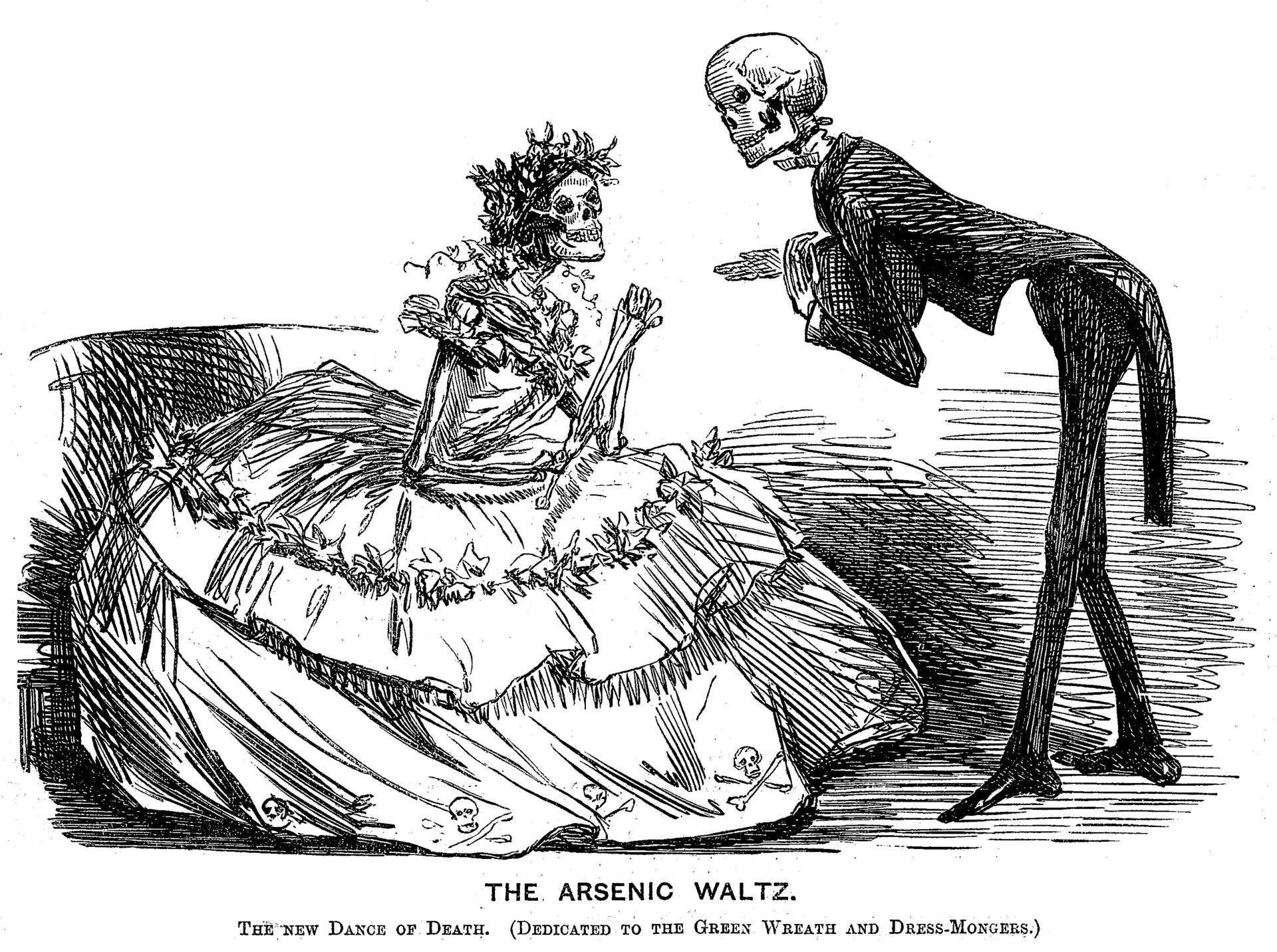
In 1861 a 19-year-old woman whose job was dusting artificial leaves with the pigment died after repeated arsenic poisoning; the autopsy found her eyes and fingernails turned green, and the case raised public awareness of the danger. The next year Punch printed “The Arsenic Waltz”, two skeletons in evening dress, dedicated to the makers of green wreaths and dresses.
The end of a colour
Some European countries began banning arsenic pigments in the 1830s and 1840s, but Scheele’s green stayed in use until the 1860s. By the 1890s the last wallpaper brand using it had stopped production, and by the early 20th century the pigment survived only as an insecticide. Its toxicity may have helped make green itself less fashionable in late Victorian homes.
The danger is still met today in libraries. The Poison Book Project at the University of Delaware and Winterthur Museum has found more than 150 nineteenth-century books coloured with emerald green, and advises handling them with care.
Green on the walls today
The shade itself has been reproduced with modern, non-toxic pigments. Papering a room is now a matter of preparation rather than risk: decorators such as Brightline, wallpaper hangers in London and Essex, strip the old paper and fill and sand the walls before a new one goes up.
Photo: “The Arsenic Waltz”, an etching published in Punch in 1862, dedicated to the makers of green wreaths and dresses. By Wellcome Collection, Wikimedia Commons, CC BY 4.0.