Roanoke’s Lost Colony and the Word “CROATOAN”
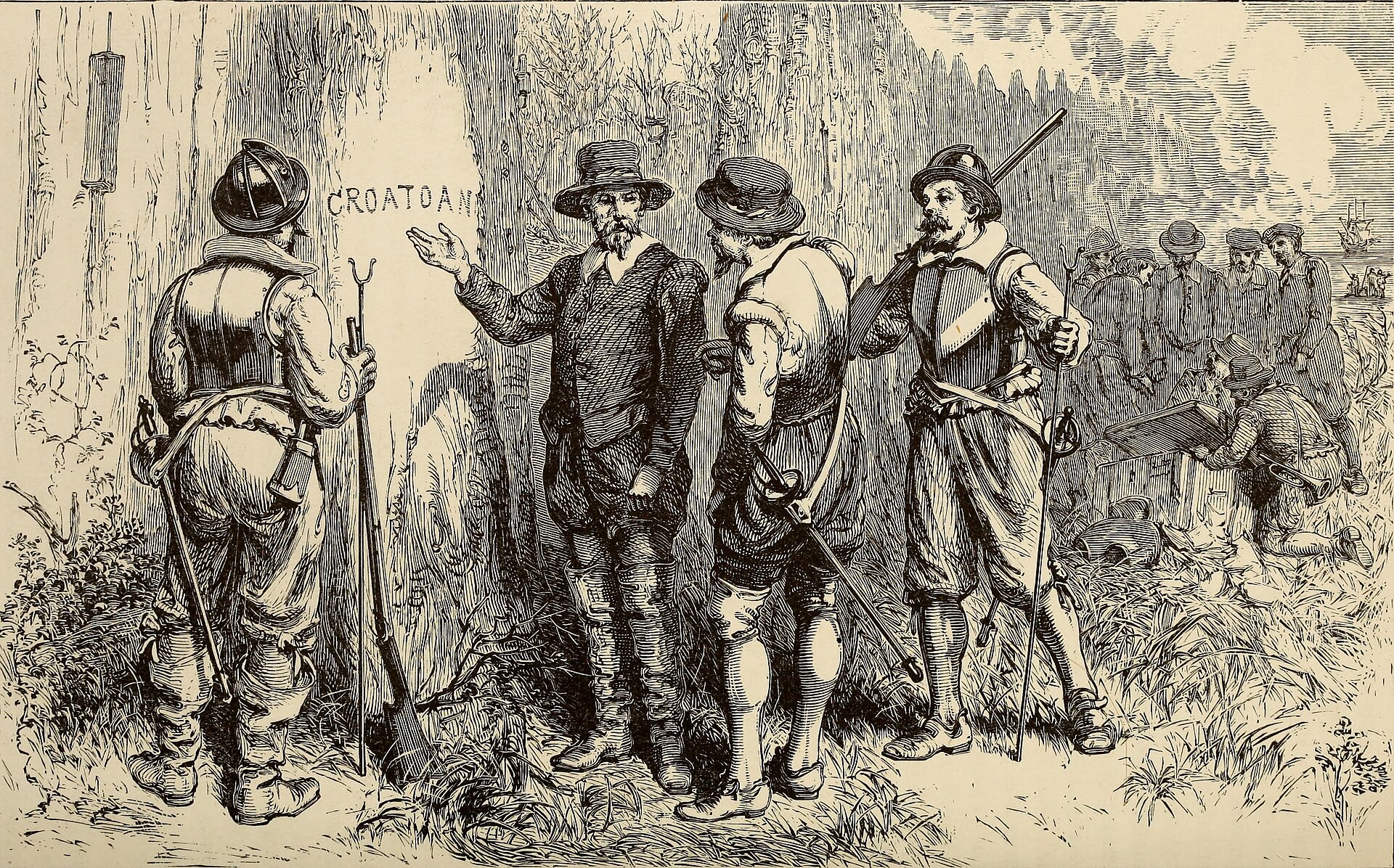
In August 1590 John White returned to Roanoke Island, off present-day North Carolina, to find the English colony he had left there three years earlier. The settlers were gone. Carved into a post of their palisade was a single word: “CROATOAN”. Their fate has never been settled, and the settlement is remembered as the Lost Colony.
Two attempts at a colony
Sir Walter Raleigh held a royal charter to settle North America. His first colony, a military outpost under Ralph Lane, was founded on Roanoke Island in 1585. Short of supplies and in conflict with local tribes, Lane’s men left with Sir Francis Drake in 1586.
A second group, with White as governor, arrived in 1587. They were bound for Chesapeake Bay, but the ship’s pilot, Simon Fernandes, left them on Roanoke. On 18 August 1587 White’s daughter Eleanor Dare gave birth to a girl, Virginia, the first English child born there. White sailed back to England that August to ask for help.
The return in 1590
War with Spain kept White away. Queen Elizabeth held ships in England as the Spanish Armada approached in 1588, and he could not return until 1590. He landed on 18 August, his granddaughter’s third birthday. The party found the letters “CRO” carved on a tree and “CROATOAN” on a post. The houses had been taken down and anything portable removed; trunks had been dug up and looted. In 1587 the colonists had agreed to leave a sign showing where they had gone, with a cross if they were in danger. There was no cross, and White took the word to mean they had moved to Croatoan Island, home of the Croatan people. A broken anchor cable and rough seas forced his ship back to England before he could look there.
Theories and digs
As early as 1605 writers suggested the settlers had joined nearby Native peoples. The explorer John Lawson, who visited Hatteras Island in the early 1700s, reported that the Hatteras people said some of their ancestors had been white. More recently, archaeologists have found European objects in two places:
- at “Site X” in Bertie County, inland, where in 2017 the First Colony Foundation reported Tudor pottery and weapon fragments. The site was located through a patch on White’s 1585 map that hides a fort symbol;
- at the site of a Native village on Hatteras Island, where a dig led by Mark Horton of the University of Bristol found part of a sword and part of a gun.
Neither find has proved where the colonists went. Items left by Lane’s men in 1585–1586, or by later traders, are hard to rule out.
Photo: “CROATOAN, The Lost Colony”, a 19th-century engraving by William James Linton after a design by William Ludwell Sheppard, showing the discovery of the carved word. By Design by William Ludwell Sheppard, Engraving by William James Linton, Wikimedia Commons, No restrictions.