The Antikythera Mechanism: An Ancient Greek Gear Machine From a Shipwreck
The Antikythera mechanism is a hand-powered ancient Greek device built in the 2nd century BC to model the movements of the Sun and the Moon. It is the oldest known example of an analogue computer, and machines of similar complexity did not appear again until the 14th century in western Europe.
A lump of bronze from the seabed
Sponge divers from the island of Symi, led by Captain Dimitrios Kontos, found a wrecked cargo ship off the Greek island of Antikythera in 1900. It lay 45 metres down, and the ship itself has been dated to about 70–60 BC. With the Greek navy they brought up bronze and marble statues, pottery, glassware, jewellery and coins. In 1901 they also raised a corroded lump of bronze and wood. It went unnoticed in the National Archaeological Museum in Athens until 17 May 1902, when the archaeologist Valerios Stais and his cousin, the politician Spyridon Stais, saw a gear wheel inside one of the pieces.
What the scans showed
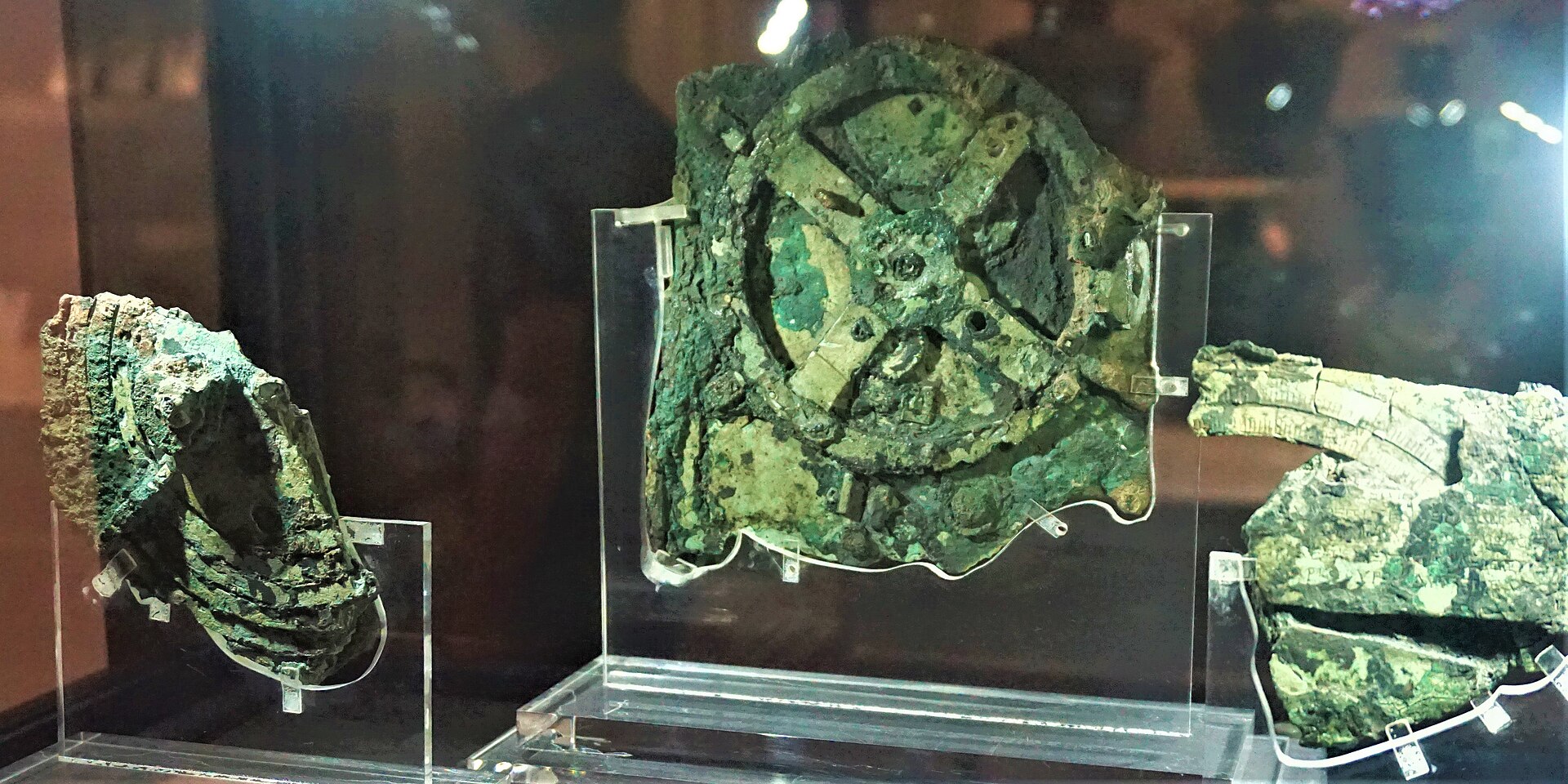
The mechanism survives as 82 fragments, seven of which hold most of its parts and inscriptions. Derek de Solla Price and Charalampos Karakalos made X-ray and gamma-ray images of them in 1971. In 2005 a team from Cardiff University led by Mike Edmunds used X-ray tomography to look inside the encrusted fragments and to read faint inscriptions. The scans suggest the device had 35 meshing bronze gears, 30 of which survive. The largest is about 13 centimetres across and had 223 teeth.
What it could do
- A hand crank turned every gear at once, moving a date pointer and showing the positions of the Sun and the Moon and the Moon’s phase.
- A spiral dial on the back followed the 18-year Saros cycle and could predict eclipses, with marks for 38 lunar and 27 solar eclipses.
- Another dial tracked the four-year cycle of the Panhellenic games, including those at Olympia.
- Its gearing followed the irregular motion of the Moon described by the astronomer Hipparchus of Rhodes.
Whether it also showed the five planets known in antiquity is still debated; if it did, that part has not survived. All the fragments are kept at the National Archaeological Museum in Athens, alongside reconstructions.
Photo: Fragments of the Antikythera mechanism on display at the National Archaeological Museum, Athens. By Joyofmuseums, Wikimedia Commons, CC BY-SA 4.0.