Reindeer Herders of the North: How Sámi Herding Works Today
Reindeer are the only semi-domesticated animal native to the far North. They are herded in nine countries, Norway, Finland, Sweden, Russia, Greenland, the United States (Alaska), Mongolia, China and Canada, and about 100,000 people around the circumpolar North work as reindeer herders.
An old way of life
How reindeer were domesticated is still debated. Rock art suggests it may first have happened in the Sayan Mountains between Russia and Mongolia, possibly 2,000 to 3,000 years ago; another theory holds that it began independently in several places.
For the Sámi of northern Scandinavia, herding was organised in the siida: a group of families sharing an area, each with its own rights but helping one another with the herds, as well as with hunting and fishing. Reindeer gave transport, milk and meat. In the 19th and 20th centuries, new state borders, between Norway and Russia in 1852 and between Sweden and Finland in 1889, cut across the siidas and disrupted traditional herding.
Herding today, country by country
About 6,500 Sámi in Scandinavia herd reindeer. In Norway and Sweden herds are large and heavily mechanised, and meat is the main product, though skins, bones and antlers matter too.
- Norway: only Sámi have the right to herd in the reindeer pasture areas, under the Reindeer Herding Act of 2007. There are six pasture territories divided into 77 areas, and about 200,000 reindeer. More than half of the industry’s costs go on running mechanical equipment.
- Sweden: the right to herd belongs only to the Sámi, through membership of one of 51 Sámi herding villages (sameby). Herding employs about 2,500 people, and there are about 4,600 reindeer owners.
- Finland: herding is not limited to the Sámi. Any EU citizen may own reindeer if accepted by one of the 56 herding districts, 41 of them in Lapland. An owner may keep at most 300 reindeer in the south of the herding area and 500 in the north.
Marks in the ear
Herds graze freely, so every reindeer is marked in the ears. In Sweden an earmark combines one or more of about 20 approved cuts, and the pattern tells who owns the animal.
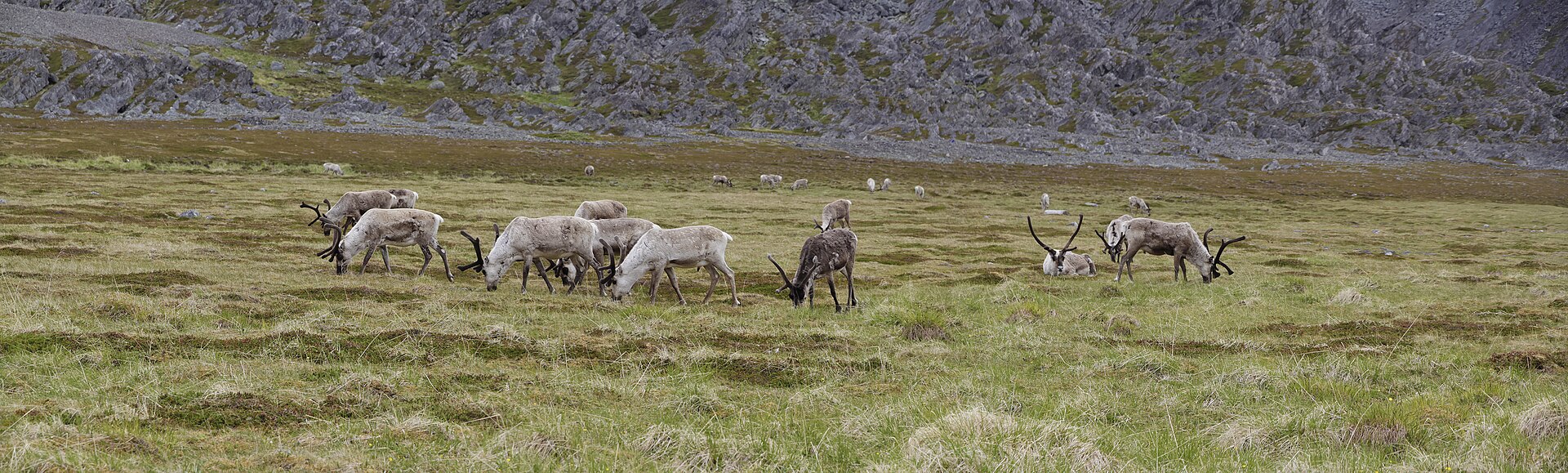
Photo: A herd of reindeer at Hamningberg in Finnmark, Norway, June 2012. By Ximonic (Simo Räsänen), Wikimedia Commons, CC BY-SA 3.0.